Perspective
Hell J Surg. 2025 Jul-Sep;95(3):145–151
doi: 10.59869/25075
Christos Kontovounisios
Director, 2nd Surgical Department, HYGEIA Hospital, Athens, Greece; IPEX Athens, HYGEIA Hospital, Athens, Greece
Adjunct Professor, Department of Surgery, NYU Grossman School of Medicine, New York, USA
Visiting Reader, Department of Surgery and Cancer, Faculty of Medicine, Imperial College London, London, UK
Visiting Professor, School of Medicine, National and Kapodistrian University of Athens, Athens, Greece
Honorary Consultant in Colorectal Surgery, The Royal Marsden NHS Foundation Trust and Chelsea and Westminster Hospital NHS Foundation Trust, London, UK

Correspondence: Christos Kontovounisios, 2nd Surgical Department, HYGEIA Hospital, Athens, Greece. E-mail: c.kontovounisios@hotmail.com
Abstract
Complex pelvic cancer surgery is no longer an isolated operation; it is the end point of a pathway that begins with referral and selection and continues through reconstruction, recovery, and survivorship. Pelvic exenteration may offer local control or cure to carefully selected patients, but its physiological and functional costs remain substantial. In this Perspective, I argue that technical capability and referral volume are not, by themselves, evidence of excellence. A Centre of Excellence should be judged by the quality of its decisions, the depth of its multidisciplinary support, its ability to measure outcomes, and its responsibility to the wider clinical network. IPEX Athens is used as an example of how such a structure can be organised, not as proof of superior results. The central proposition is simple: excellence in complex pelvic oncology must be demonstrated through transparent, patient-centred outcomes and continuous service improvement.
Key Words: Pelvic exenteration, complex pelvic oncology, centralisation, multidisciplinary care, quality improvement, centres of excellence
Submission: 18.08.2026, Acceptance: 01.11.2026
Introduction: Excellence Is More Than Technical Capability
Pelvic exenteration has moved a long way from its origins as a predominantly palliative procedure. For selected patients with locally advanced or recurrent pelvic cancer, it can now be part of a curative plan [1]. That change has not been driven by surgery alone. Better imaging, systemic treatment, radiotherapy, anaesthesia, critical care, reconstruction, and rehabilitation have all widened the group of patients who can be considered for radical treatment. The operation itself has also changed: a planned resection may involve the pelvic sidewall, sacrum, iliac vessels, urinary tract, neural structures, or major soft-tissue reconstruction.
There is a risk in complex surgery of confusing technical reach with excellence. A service must be able to decide who should be considered for surgery, define the likely planes of resection, anticipate reconstruction, explain the functional consequences honestly, and support the patient when recovery is prolonged or complications occur. None of these responsibilities belongs to a single surgeon. They belong to a dedicated system.
The Greek experience provides a useful illustration. A national survey showed variation in experience and perioperative practice and strong support for clearer standards and more centralised pathways [2]. A later single-centre series from Evangelismos General Hospital reported an R0 resection in 16 of 18 patients, but also showed the morbidity and resource intensity of these operations [3]. I regard those two observations as complementary: concentration of expertise is important, but operative volume or margin status alone cannot describe the quality of a service.
This Perspective therefore takes the discussion one step further. Centralisation is necessary, but it is not the end point. The more important question is what a centre should be accountable for once complex pelvic cancer care has been concentrated within it?
Why Centralisation Matters
Locally advanced and recurrent rectal cancer may involve the bladder, prostate, vagina, pelvic sidewall, sacrum, or iliac vessels; selected gynaecological, urological, anal, and soft-tissue malignancies create similar problems. The chance of complete resection, which remains closely linked to long-term outcome, depends on careful anatomical assessment and coordinated planning across specialties [5-8].
Centralisation makes that coordination easier to reproduce. Radiologists, pathologists, surgeons, oncologists, anaesthetists, specialist nurses, rehabilitation teams, and reconstructive services become accustomed to working together on the same type of difficult case. The institution can also maintain practical systems for major haemorrhage, long operations, critical-care support, complex wounds, stoma care, and early rehabilitation. The PelvEx minimum standards reflect this wider view by emphasising referral arrangements, specialist imaging, multidisciplinary infrastructure, perioperative capability, and prospective audit [5].
I would nevertheless avoid using annual case volume as the sole parameter for quality. Repeated exposure matters, but so do case mix, anatomical complexity, patient selection, team stability, rescue capability, and the discipline with which outcomes are recorded. Benchmark data are useful because they allow a centre to place its results in context, but they only become meaningful when interpreted alongside the patients who were selected and the pathway through which they were treated [11].
From Specialist Service to Accountable Centre
For practical purposes, I find it helpful to think of service development in four stages (Figure 1). A pelvic exenteration service can perform the operation. A specialist referral centre adds a concentration of difficult cases and relevant expertise. A Centre of Excellence goes further by accepting formal responsibility for governance, prospective data, external comparison, patient-reported outcomes, training, research, and succession. The most mature model is a network in which the specialist centre remains linked to referring hospitals through agreed pathways, virtual review, shared care, and transparent reporting.
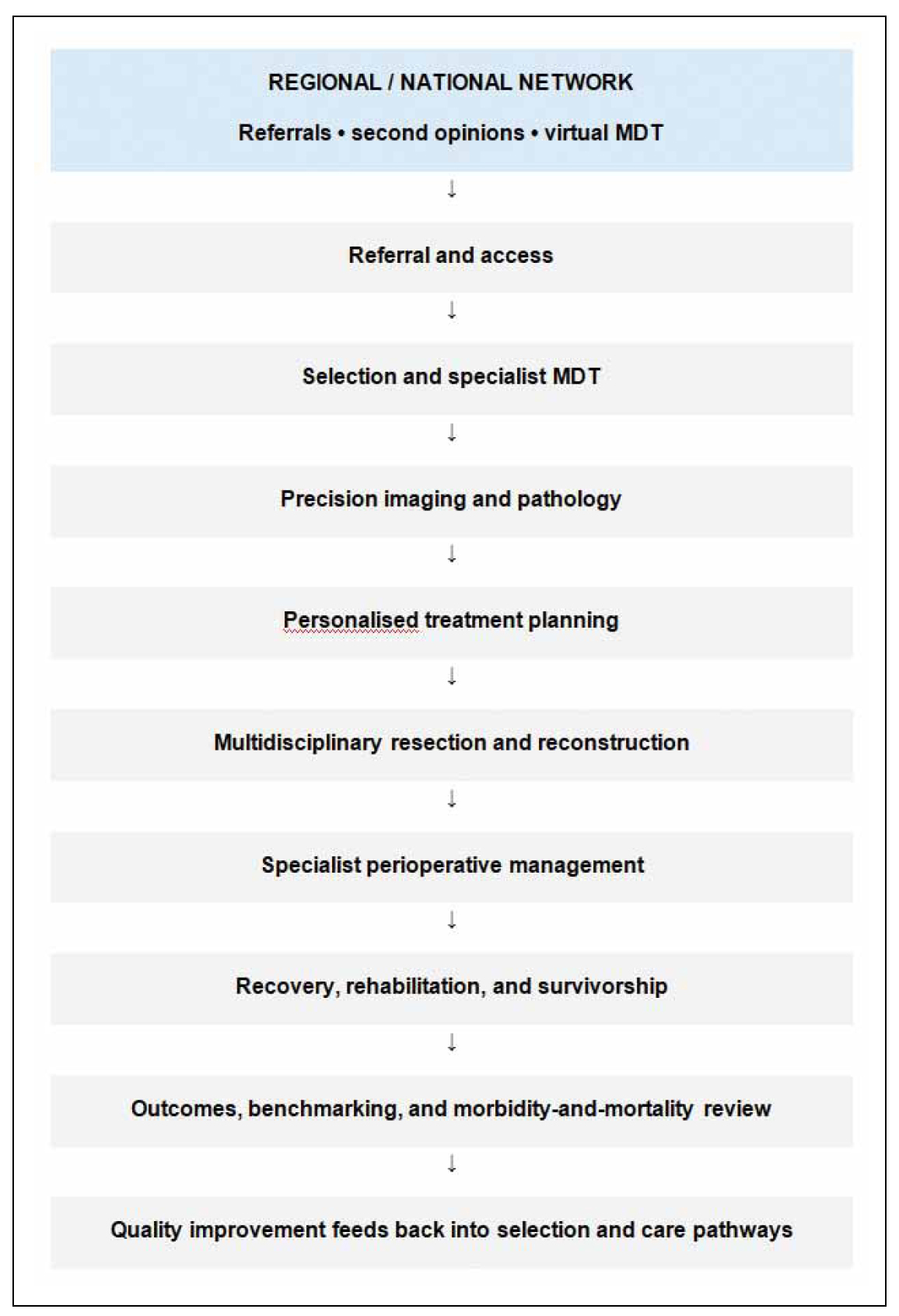
Figure 1. From procedural capability to accountable excellence. Proposed stages of maturity: (1) pelvic exenteration service; (2) specialist referral centre; (3) Centre of Excellence; and (4) accountable pelvic oncology network.
This distinction is more than terminology. The phrase ‘Centre of Excellence’ should not function as a self-awarded title. Minimum standards tell us what is needed to practise safely. Excellence requires evidence that the service can identify its own shortcomings, act on them, and improve access and outcomes beyond the walls of the institution (Table 1).
Core Components of an Accountable Service
Referral, access, and selection
The first responsibility of a specialist centre is selection, not surgery. Patients with potentially resectable advanced or recurrent disease should have access to assessment by a team that can judge the anatomy, previous treatment, metastatic burden, physiological reserve, symptoms, and the patient’s own priorities. The discussion must also ask whether the likely oncological benefit justifies the functional price of treatment.
Referral needs to be straightforward and timely. Second opinions and virtual multidisciplinary review are particularly valuable for patients who live far from the specialist centre. Centralisation should not force every part of the pathway into one hospital. Local teams remain essential for diagnosis, systemic treatment, surveillance, rehabilitation, and survivorship; the specialist centre should concentrate the decisions and interventions that genuinely require concentrated expertise (Figure 2).
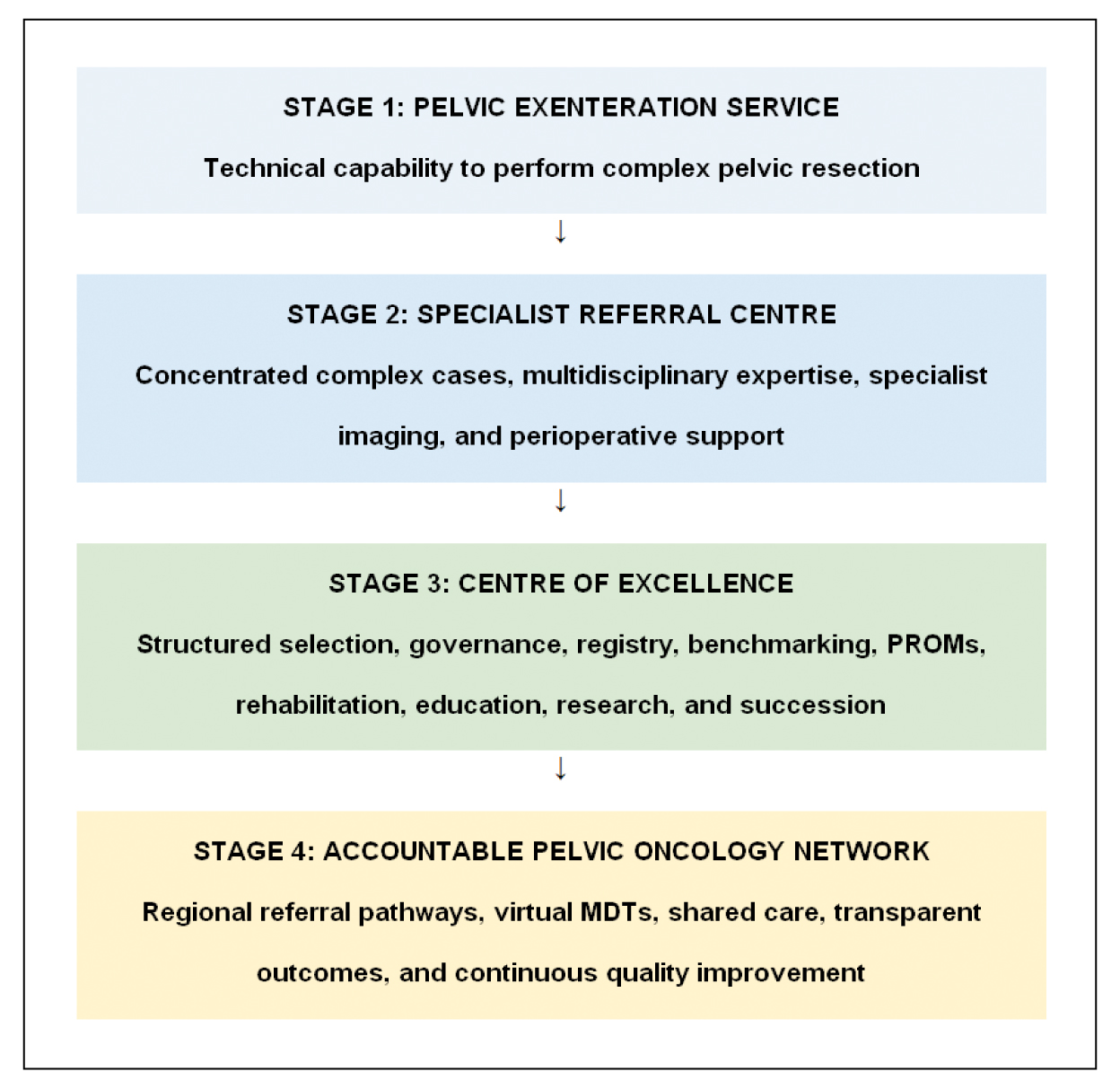
Figure 2. Patient-centred governance model for complex pelvic oncology. The pathway runs from referral and access to specialist assessment, imaging and pathology, personalised planning, multidisciplinary surgery and reconstruction, perioperative care, rehabilitation and survivorship, and prospective outcome review. Clinical, outcome, professional, and network governance support each stage. Results feed back into pathway design and future decision-making.
Multidisciplinary decision-making
The pelvic oncology multidisciplinary team is where the service either becomes coherent or fragments. Its core membership should include pelvic oncological or colorectal surgeons, specialist radiologists, pathologists, medical oncologists, radiation oncologists, urologists, and specialist nurses. Vascular, orthopaedic or spinal, plastic and reconstructive, gynaecological, pain, nutrition, rehabilitation, palliative-care, and anaesthetic expertise should be available when the planned treatment requires it [5].
A useful MDT record should contain more than a binary decision to operate or not operate. It should state the intent of treatment, the anatomical extent of disease, the margins at risk, the structures likely to require en bloc resection, the reconstructive plan, alternatives to surgery, expected morbidity, and the patient’s priorities. I would also include declined cases in formal review. Understanding why surgery was not offered is part of understanding how a centre selects patients, and it makes later audit of decision-making possible.
Imaging, pathology, and operative planning
In complex pelvic surgery, imaging is part of the operation before the patient reaches theatre. High-resolution pelvic MRI, structured reporting, and direct review between radiology and the surgical team help define threatened margins and map the compartments that may need to be resected [13]. CT and PET/CT have complementary roles depending on tumour type, prior treatment, and the clinical question.
The same principle applies after surgery. Pathology should not sit separately from radiology and operative planning; standardised margin reporting and case review allow the three disciplines to learn from each other. Planning should remain anatomy-led. The practical question is which structures must be removed to obtain an oncologically meaningful clearance, and which can be preserved without compromising that aim.
Operative and perioperative capability
An excellent service is an institutional team, not a named operator. When the anatomy requires it, urological, vascular, orthopaedic, gynaecological, and reconstructive expertise should be planned in advance rather than called for after the operation has started. Specialist anaesthesia, blood-bank support, interventional radiology, critical care, theatre and ward nursing, stoma therapy, nutrition, and physiotherapy are equally important [5,14].
These services also need to agree on how patients are prepared and rescued. Prehabilitation, nutritional optimisation, anaesthetic assessment, venous-thromboembolism prevention, haemorrhage planning, analgesia, wound care, stoma education, and mobilisation should be built into the pathway. Radical surgery should never be discussed as if the operation were separate from the preparation and postoperative systems that make it tolerable and, when things go wrong, survivable.
Recovery and survivorship
Patients live with the consequences of exenterative surgery long after the pathology report has been filed. Urinary and bowel diversion, sexual dysfunction, pain, impaired mobility, fatigue, psychological distress, and social consequences can remain important months or years after discharge. These possibilities deserve explicit discussion before treatment, including the likely course of rehabilitation and the alternatives to radical surgery.
A centre that claims excellence should therefore provide more than follow-up scans. Stoma care, nutrition, physiotherapy, pain management, psychological support, and sexual-health counselling should be available when relevant. Patient-reported outcome measures are still used inconsistently in the literature [18], but recent consensus work has made the priorities clearer: survival and recurrence matter, but so do margin status, quality of life, physical and psychological function, and independent mobility [19].
Measurement, benchmarking, and improvement
A prospective registry is the practical backbone of accountability. At a minimum, it should capture where the patient was referred from, how long assessment took, the MDT decision, treatment intent, operative complexity, pathology, complications, reinterventions, readmission, length of stay, 30- and 90-day mortality, survival, functional recovery, and patient-reported outcomes. Common terminology, including the Pelvic Exenteration Lexicon, makes comparison between centres more credible [15].
No single metric should dominate that assessment. R0 rate and procedural volume are important, but published studies have used heterogeneous definitions and reporting standards [17]. Regular morbidity-and-mortality review, examination of near misses, and comparison with external benchmarks should lead to visible changes in practice. Service measures deserve the same attention. Delays from referral to review or from decision to treatment can undermine a technically excellent operation, and they are often easier to improve than the biology of the cancer.
Education, research, and network responsibility
A field this specialised cannot remain dependent on a handful of individuals. Training needs to include judgement, imaging interpretation, complication management, reconstruction, recovery, and audit as well as operative technique. Prospective registries, collaborative studies, technical standardisation, and multidisciplinary education are the mechanisms by which experience becomes transferable rather than personal [20,21].
The same principle applies to the centre’s relationship with referrers. Clinicians outside the specialist unit need clear criteria, reliable communication, and timely advice. Virtual MDT review can spare patients unnecessary travel, while shared-care arrangements can return suitable parts of treatment and follow-up to local teams without losing specialist oversight for the highest-risk decisions [10].
IPEX Athens as an Implementation Example
IPEX Athens was established at HYGEIA Hospital in July 2026 to coordinate assessment and treatment for patients with complex pelvic malignancy [22]. Its intended structure includes multidisciplinary planning, advanced pelvic surgery, specialist imaging and oncology input, critical care, rehabilitation, prospective data collection, education, and professional collaboration. I describe it here because it provides a current example of how the organisational principles discussed above can be assembled within a new service.
Referral activity, time to decision, selection, resection margins, morbidity, mortality, functional recovery, patient experience, and continuity with referring teams should all be reported prospectively. Negative findings will be as important as positive ones if they lead to changes in the pathway. The previously published 18-patient series was undertaken at Evangelismos General Hospital before IPEX Athens was established [3], and those results should remain clearly attributed to that earlier public-hospital experience.
From Centres to Networks
The next development in complex pelvic oncology should be a move away from informal claims of expertise towards explicit standards that can be audited. The PelvEx minimum standards provide a baseline [5]; benchmark data provide context for performance [11]; and patient-centred outcome work broadens the definition of success beyond the operation itself [19]. Together, these strands make it possible to discuss excellence in terms that are testable rather than promotional.
Any future accreditation system should be cautious about setting a single annual case-number threshold. Volume matters, but it does not describe anatomical complexity, referral patterns, team depth, selection quality, perioperative infrastructure, functional outcomes, or contribution to the wider network. In smaller countries, a hub-and-spoke model may be particularly practical: difficult cases can be reviewed centrally, major surgery can be concentrated where the full team is available, and appropriate elements of care can remain close to the patient’s home.
Conclusion
Complex pelvic oncology requires more than technical proficiency. Centralisation matters because it brings together the people and infrastructure needed for difficult decisions and demanding surgery. The quality of the service, however, is revealed across the whole pathway: who reaches specialist review, how decisions are made, how complications are anticipated and managed, what happens during recovery, which outcomes are measured, and whether the organisation changes when results are not good enough.
For that reason, I do not think a Centre of Excellence should be defined by prestige, ownership, or the ability to perform pelvic exenteration. It should be defined by accountable multidisciplinary care and by outcomes that matter to patients. The broader objective is not to create a label. It is to create a service in which complex pelvic cancer patients reach the right expertise in time, receive a well-reasoned treatment recommendation, and can see that the centre is prepared to measure, report, and improve the care it provides.
Conflict of Interest
C.K. is Director of IPEX Athens, HYGEIA Hospital. IPEX Athens is discussed as an implementation example. No clinical outcomes from IPEX Athens are reported in this Perspective.
Funding
No specific funding was received for preparation of this Perspective.
Data Availability
No new patient-level data were generated or analysed.
Ethics Statement
Not applicable. This article does not report new human-subject research.
Author Contributions
C.K. conceived the article, developed the framework, and reviewed and approved the final manuscript.
References
- Kontovounisios C. Dictum of success in pelvic exenterative surgery. Hell J Surg. 2024 Jan-Mar;94(1):5–6. Doi:10.59869/23021.
- Greek Pelvic Exenteration Collaborative, Bikas K, Papaeleftheriou S, Giannos G, Tseliou V, Chrysikopoulou A, Katsimente S. Pelvic exenteration for locally advanced rectal cancer (LARC) and locally recurrent rectal cancer (LRRC) in Greece: A national snapshot survey of current practice. Hell J Surg. 2024 Jul-Sep;94(3):115–41. Doi:10.59869/24037.
- Bikas K, Matsagkos D, Papaeleftheriou S, Tseliou V, Katsimente S, Chrysikopoulou A, et al. Perioperative outcomes and morbidity following pelvic exenteration surgery: a single-centre experience. Hell J Surg. 2025 Apr-Jun;95(5):78–85. Doi:10.59869/25064.
- Kontovounisios C, Tan E, Pawa N, Brown G, Tait D, Cunningham D, et al. The selection process can improve the outcome in locally advanced and recurrent colorectal cancer: activity and results of a dedicated multidisciplinary colorectal cancer centre. Colorectal Dis. 2017 Apr;19(4):331-8. Doi:10.1111/codi.13517.
- PelvEx Collaborative. Minimum standards of pelvic exenterative practice: PelvEx Collaborative guideline. Br J Surg. 2022 Nov;109(12):1251-63. Doi:10.1093/bjs/znac317.
- PelvEx Collaborative. Surgical and survival outcomes following pelvic exenteration for locally advanced primary rectal cancer: Results from an international collaboration. Ann Surg. 2019 Feb;269(2):315-21. Doi:10.1097/SLA.0000000000002528.
- PelvEx Collaborative. Factors affecting outcomes following pelvic exenteration for locally recurrent rectal cancer. Br J Surg. 2018 May;105(6):650-7. Doi:10.1002/bjs.10734.
- PelvEx Collaborative. Pelvic exenteration for advanced nonrectal pelvic malignancy. Ann Surg. 2019 Nov;270(5):899-905. Doi: 10.1097/SLA.0000000000003533
- Traeger L, Bedrikovetski S, Oehler MK, Cho J, Wagstaff M, Harbison J, et al. Short-term outcomes following development of a dedicated pelvic exenteration service in a tertiary centre. ANZ J Surg. 2022 Oct;92(10):2620-7. Doi:10.1111/ans.17921.
- Fitzsimmons T, Thomas M, Tonkin D, Murphy E, Hollington P, Solomon M, et al. Establishing a state-wide pelvic exenteration multidisciplinary team meeting in South Australia. ANZ J Surg. 2023 May;93(5):1227-31. Doi:10.1111/ans.18220.
- Brown KGM, Solomon MJ, Koh CE, Sutton PA, Aguiar SJr, Bezerra TS, et al. Defining benchmarks for pelvic exenteration surgery: a multicentre analysis of patients with locally advanced and recurrent rectal cancers. Ann Surg. 2025 Dec;282(6):1118-26. Doi:10.1097/SLA.0000000000006348.
- Humphries EL, Kroon HM, Dudi-Venkata NN, Thomas ML, Moore JW, Sammour T. Short- and long-term outcomes of selective pelvic exenteration surgery in a low-volume specialized tertiary setting. ANZ J Surg. 2019 Jun;89(6):E226–E230. Doi: 10.1111/ans.15212
- Nougaret S, Lambregts DMJ, Beets GL, Beets-Tan RGH, Blomqvist L, Burling D, et al. Imaging in pelvic exenteration—a multidisciplinary practice guide from the ESGAR-SAR-ESUR-PelvEx collaborative group. Eur Radiol. 2025 May;35(5):2681-91. Doi:10.1007/s00330-024-10940-z.
- PelvEx Collaborative. Perioperative management and anaesthetic considerations in pelvic exenterations using Delphi methodology: results from the PelvEx Collaborative. BJS Open. 2021 Jan;5(1):zraa055. Doi:10.1093/bjsopen/zraa055.
- Burns EM, Quyn A; Lexicon Collaboration of UKPEN and the ACPGBI Advanced Cancer Subcommittee. The Pelvic Exenteration Lexicon: creating a common language for complex pelvic cancer surgery. Colorectal Dis. 2023 May;25(5):888–96. Doi:10.1111/codi.16476.
- PelvEx Collaborative. Contemporary results from the PelvEx Collaborative: improvements in surgical outcomes for locally advanced and recurrent rectal cancer. Colorectal Dis. 2024 May;26(5):926-31. Doi:10.1111/codi.16948.
- Brown KGM, Pisaniello J, Ng KS, Solomon MJ, Sutton PA, Hatcher S, et al. Variation in outcome measurement and reporting in studies of pelvic exenteration for locally advanced and recurrent rectal cancer: a systematic review. Colorectal Dis. 2024 Feb;26(2):272-80. Doi:10.1111/codi.16844.
- Denys A, van Nieuwenhove Y, Van de Putte D, Pape E, Pattyn P, Ceelen W, et al. Patient-reported outcomes after pelvic exenteration for colorectal cancer: a systematic review. Colorectal Dis. 2022 Apr;24(4):353–68. Doi:10.1111/codi.16028.
- Brown KGM, Morkaya J, Solomon MJ, Ng K-S, White K, Sutton P, et al. Priority outcomes of pelvic exenteration for rectal cancer: a patient, carer, and clinician consensus. Br J Surg. 2024 Nov;111(12):znae298. Doi:10.1093/bjs/znae298.
- Steffens D, Solomon MJ, Lee P, Austin K, Koh C, Byrne C, et al. Surgical, survival and quality of life outcomes in over 1000 pelvic exenterations: lessons learned from a large Australian case series. ANZ J Surg. 2023 May;93(5):1232-41. Doi: 10.1111/ans.18356.
- Brown KGM, McBride KE, Anderson T, Solomon MJ. Delivering complex surgical services: lessons learned from the evolution of a specialised pelvic exenteration centre. Aust Health Rev. 2023 Dec;47(6):735-40. Doi:10.1071/AH23186.
- HYGEIA Hospital. HYGEIA Hospital establishes IPEX Athens: International Centre for Advanced Pelvic Oncology and Pelvic Exenteration [Internet]. Institutional announcement. 8 July 2026. Available from: https://www.hygeia.gr/en/press-release/hygeia-hospital-establishes-ipex-athens-international-centre-for-advanced-pelvic-oncology-and-pelvic-exenteration/