Brief Communication
Hell J Surg. 2025 Apr-Jun;95(5):103–106
doi: 10.59869/25069
Surajit Bhattacharya1, Kaushik Bhattacharya2
1MS M.Ch (Plastic Surgery), Consultant Plastic Reconstructive & Aesthetic Surgery, Ajanta Hospital, Lucknow, India,
2MS DNB MNAMS FAIS FACS FRCS (Glasg) FRCS (Edin), Associate Professor, Department of Surgery, Mata Gujri Memorial Medical College and LSK Hospital, Kishanganj, Bihar, India

Correspondence: Dr. Surajit Bhattacharya, C 907, Mahanagar, Sector-B, Lucknow 226006, India, e-mail: surajitbh@yahoo.co.in
Abstract
Surgical decision-making is a complex, high-stakes process requiring a blend of clinical expertise, emotional regulation, situational awareness, and rapid judgment. Like pilots, surgeons often rely on both established protocols and instinct when navigating crisis situations. While structured frameworks—such as “Avoid, Trap, Mitigate”—enhance decision quality, emotional factors like hunger, anger, loneliness, tiredness, pain, and stress (HALT-PS) can significantly impair judgment. These emotions may cause errors of omission, commission, or flawed planning, contributing to surgical complications or “Never Events.” Simulation-based training, team communication, and adaptive protocols derived from aviation have been shown to enhance crisis performance and mitigate human error. Over-reliance on technology without contingency planning, such as robotic tools, further jeopardises outcomes. Ultimately, the surgeon bears the burden of decisions that can determine life or death. Recognising and mitigating emotional and systemic vulnerabilities is vital for safe, patient-centred surgical care.
Key Words: Decision making, emotions, patient safety
Submission: 26.07.2025, Acceptance: 21.04.2026
Introduction
The basic guideline is “would you have this done to yourself, your wife, your child, your parent?”
Mark M. Ravitch (1910–1989)
Surgical decision-making involves a systematic approach to evaluating clinical scenarios, utilising evidence-based guidelines, and considering various factors to ensure optimal patient outcomes. It is a critical process that encompasses the evaluation of patient conditions, the selection of appropriate surgical interventions, and the management of potential risks and complications. It is guided by evidence-based practices and protocols that enable surgeons to navigate complex clinical scenarios effectively. However, there are crisis occasions when a surgeon often goes by their ‘gut feeling,’ which have a foundation in their training and experience, and yet are substantially emotional. Pilots, too at times confront crisis occasions when they act on their gut instincts and on January 15, 2009, Chesley Sullenberger and First Officer Jeffrey Skiles managed to land US Airways flight 1549 on the Hudson River and save 150 lives. Both pilots and surgeons must make rapid, high-stakes decisions during unexpected emergencies—such as engine failure mid-flight or sudden hemorrhage during surgery. These situations demand exceptional situational awareness, mental resilience, and the ability to prioritise under pressure. Both rely on extensive training, protocols, and experience, but also need adaptability when standard procedures fall short. Surgeons make complex, individual decisions during procedures, impacting a single patient, while pilots make critical decisions in a dynamic environment, potentially affecting many lives. Both professions, however, are vulnerable to errors due to fatigue, stress, and cognitive biases.
Human factors in Surgical response
Simulation-based training in both fields enhances cognitive flexibility and crisis response. Real-time data, teamwork, and calm leadership are critical to minimising harm. The shared emphasis on non-technical skills and structured responses underpins their ability to perform life-saving decisions within seconds. A study recommended the ‘Patient, Procedure, People’ protocol, a tool adapted from aviation threat and error management training. It allows surgical teams to improve situational awareness, effective communication, flatten hierarchical gradients, and improve decision-making before responding to critical events [1]. The study found poor decision-making, with resulting errors due to tunnel vision, acute stress reactions (fight–flight or freeze–hide) and limbic hijacking (surprise and startle events). Air Accident Investigation Branch (AAIB) concluded that fatal accidents are frequently caused by pilots flying outside their own personal limits, those of the aircraft, or the environment. Similarly, for a surgeon, patient morbidity or mortality may occur if they work outside their personal capability, with poor procedure selection and patient optimisation, or with a team or theatre environment not suited to the procedure [2]. For the surgeon, another aspect of poor decision making is too much dependence on the surgical tool, like a robot or laparoscope, without an alternative bailout option applied, as described by Abraham Maslow as the “law of the instrument” or “Maslow’s hammer” as “it is tempting, if the only tool you have is a hammer, to treat everything as if it were a nail” [3]. Both pilots and surgeons must make critical decisions under pressure, but their approaches and priorities differ. Pilots rely on established protocols and automation, aiming to maintain situational awareness and anticipate potential problems. Surgeons, while also valuing situational awareness, may need to act more rapidly in life-threatening situations, sometimes improvising based on their expertise and the specific context.
Surgeons sometimes make terrible decisions when they rely solely on their emotions, which can sometimes change in the blink of an eye, along with the justifications for the actions they’ve taken or the merits of certain actions. This is because strong emotions intensely focus our thinking and neutralise the influence of other inputs from the environment, logic, various reminders, and past decisions. The evidence-based crisis management framework in surgery has been based on the commercial aviation industry policy of “Avoid, Trap, and Mitigate.”Avoid prevents harm through preparation; Trap corrects emerging failures; Mitigate contains crises to stabilise situations, prioritising safety, teamwork, and critical decision-making [4].
In surgery, decision-making situations come with alarming regularity. There are life-or-limb-threatening situations that a surgeon encounters often, and every time he/she is challenged to make a correct decision, because the alternative can prove to be costly for the patient. So, should a particular trauma patient be sent to the operating theatre for early surgery or to radiology for an accurate diagnosis, can a pregnant woman wait for a normal delivery or be taken for a Cesarean section, should this dismembered lower limb be sacrificed or replanted are decisions which a surgeon is expected to take almost every day. Yes, they are trained to do so, and yes, there are Standard Operating Procedures (SOPs) and, most importantly, there is Artificial Intelligence (AI) to fall back upon today, but the ultimate responsibility is that of the surgeon.
However, there are times when we falter, and make a wrong decision, usually by bypassing the SOPs. Why do you think this happens? Over the years, we have, from our experience, realised that six human emotions are the real culprits. We must be aware of them and know how to neutralise them to improve our decision making.
Ken Shubin Stein, who started as a professor at Columbia University Graduate School of Business, then decided to become a neurologist to know how the mind works, uses the acronym HALT-PS to describe these six factors that impair our judgment [5]. These are:
Hunger
Anger
Loneliness
Tiredness
Pain
Stress
These six emotions are a big stop sign. They shouldn’t be ignored lest we end up with a surgical complication due to a human error (act of commission, act of omission, error of execution, and error of planning), communication error, system failure, or equipment failure [6].There are experiences from everyday life that clearly prove that these six emotions are real culprits in decision-making, and yet are not always clearly linked to bad decision-making. These six emotions somehow don’t allow us to see the full picture, which probably includes many important details and many different facets. For instance, having interrupted his dinner a surgical registrar might have to rush to attend a head injury patient but while doing a detailed neurological examination and establishing the Glasgow Coma Scale score, he is still remembering the dinner that awaits him in his cabin, and in this rush forgets to examine the abdomen and so misses a solid organ trauma, which is the cause of shock! He is trained to examine the entire patient, but hunger has clouded his decision-making. There is a current lack of robust evidence and empirical data directly linking specific interventions like the proposed HALT-PS to a quantitative reduction in actual surgical errors. Research in this area often highlights the systemic challenges in tracking and reporting surgical error data and acknowledges that many widely used safety protocols, such as the Universal Protocol, have not been evaluated through randomised controlled studies with actual patient outcomes.
A surgical “Never Event” is a preventable error occurring immediately before, during, or immediately following surgery and to prevent ‘Never Event’, “one size fits all” safety approach should not be the dictum and each Operating Room should perform a risk assessment relative to the occurrence of Never Events during a specific surgery and make tailored adjustments in the safety standards [7].
Framework and analogy from the aviation industry
Literature always compares the role of surgeons versus pilots whenever there is a crash or accident, but the fact remains that excessive use of the aviation-healthcare safety paradigm in surgery can lead to misleading generalisations and end-user disengagement. Both pilots and surgeons are trained professionals, but a surgical operation is more variable and volatile than aeronautical engineering without any radar or sophisticated gadgets for turbulence control or bailout option in the middle of the surgical procedure when the patient bleeds or gasps, making the surgeon’s job highly risky, hazardous, challenging, and unpredictable [8]. The best protocol for a surgeon to follow in a crisis is probably the SHELL model, which was originally developed for aviation human factors analysis. The SHELL model in surgery emphasises interaction between Software (protocols, checklists), Hardware (equipment), Environment (light, noise), and Liveware—both individual (surgeon, anaesthetist) and group (team dynamics). It highlights how human factors influence performance, decision-making, and patient safety within the complex environment of the operating theatre, promoting systems-based surgical safety [9].
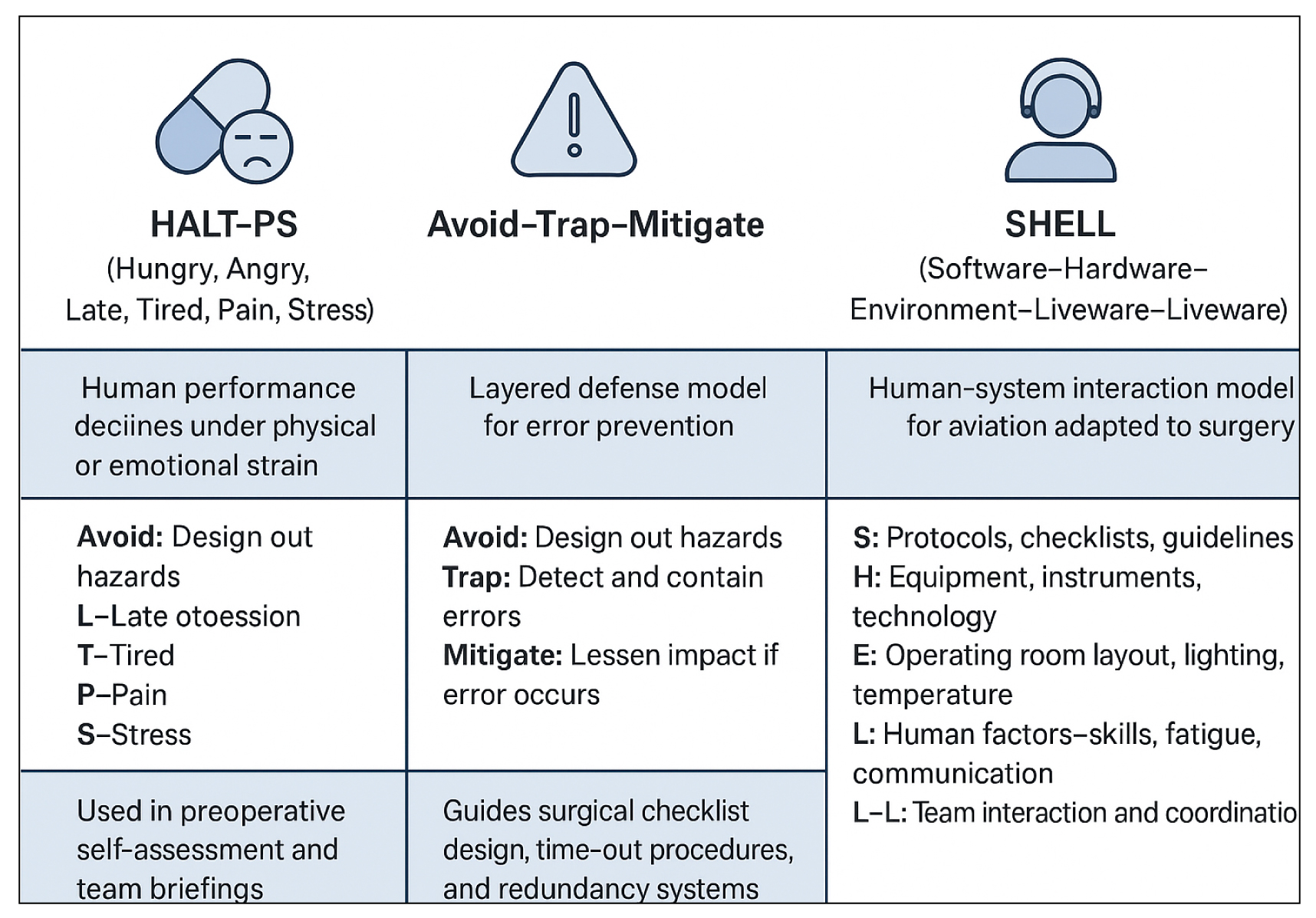
Figure 1. Key frameworks (HALT-PS, Avoid–Trap–Mitigate, SHELL) and their application to surgery.
Practical Recommendations for Surgeons
In a nutshell, hunger, anger, loneliness, tiredness, pain, and stress are the emotions that are most dangerous to our decision-making, and for a surgeon, they may prove fatal. It’s not always possible to assess their impact on us before making important decisions, but it’s worth trying, and over time, we can develop greater awareness of these emotions and be able to avoid decisions that we might regret later. Remember, being aware of these emotions doesn’t mean they’ll disappear, and it’s very hard to neutralise them without taking action. So, if necessary, it is better for the surgeon to go for healthy food to combat hunger, call a loved one for a short conversation, lie down for a half-hour rest, or take any similar action to ensure he is the mental state that allows him to make the best decisions.
The cognitive engineering strategies for surgical error management in cardiothoracic surgery are task shedding (task shedding involves deliberately reducing or deferring less critical tasks when cognitive load is high, for example, during a cardiac arrest or unexpected bleeding), intelligent interruption systems (interruptions during surgery (e.g., phone calls, monitor alarms, or conversations) can disrupt concentration and cause mistakes. Intelligent systems ensure that only essential alerts reach the surgeon during critical phases), sterile cockpit (borrowed from aviation, the “sterile cockpit” rule limits nonessential communication during high-risk periods of surgery), short breaks (a 2–3 minute “microbreak” during long valve repairs helps maintain steady hands and sharper decision-making, preventing fatigue-related errors), team strengthening (enhances coordination, mutual trust, and error recovery. Teams that communicate effectively can recognise and correct small errors before they escalate), pre-incision time-out (ensures shared situational awareness and prevents “wrong site” or “wrong patient” errors), safety systems for device interoperability (integrating and coordinating multiple devices (anesthesia monitors, bypass machines, defibrillators, etc.) to share data and avoid conflicting outputs), workload-adaptive associate systems (these are smart, artificial intelligence -assisted systems that dynamically adjust assistance levels based on the surgeon’s or team’s workload.), and cognitive aids for high-risk/low-frequency situations (structured checklists, flowcharts, or digital prompts that guide decision-making in rare but dangerous situations) [10].
Conclusion
Surgical decision-making in crisis situations demands not only clinical expertise but also emotional intelligence and situational awareness. While structured frameworks like “Avoid, Trap, Mitigate” and models such as SHELL enhance safety, the influence of human emotions—hunger, anger, loneliness, tiredness, pain, and stress—can compromise judgment and lead to preventable errors or “Never Events.” Recognising and addressing these vulnerabilities through simulation-based training, effective communication, and self-awareness is crucial. Surgeons must balance technology, protocol, and intuition while maintaining composure under pressure. Ultimately, safeguarding patient outcomes depends on integrating technical proficiency with emotional resilience and sound cognitive control during crisis decision-making.
“It is preferable to use superior judgment to avoid having to use superior skills”.
Conflict of Interest
Nil
Funding Obtained
Nil
Authors Contribution
Conception and design of the study – Surajit, Kaushik. Acquisition of data- Surajit, Kaushik. Drafting of the article – Surajit. Critical revising – Kaushik. Final approval- Surajit, Kaushik
References
- Hardie JA, Hunn D, Mitchell TE, Brennan PA. Patient, Procedure, People (PPP): Recognising and responding to intraoperative critical events. Ann R Coll Surg Engl. 2022 Jun;104(6):409-13. Doi: 10.1308/rcsann.2021.0193
- Hardie JA, Brennan PA. The personal limitations checklist: human factors insights from air accidents to reduce intraoperative harm. Br J Oral Maxillofac Surg. 2021 Oct;59(8):853-7. Doi: 10.1016/j.bjoms.2020.12.007
- McDonald WM. The problem with maslow’s hammer. Am J Geriatr Psychiatry. 2022 Dec;30(12):1324-6. Doi: 10.1016/j.jagp.2022.06.002
- Gogalniceanu PM, Karydis N, Loukopoulos I, Kessaris N, Sevdalis N, Mamode N. Avoid, trap, and mitigate: Development of an evidence-based crisis management framework in surgery. J Am Coll Surg. 2021 Oct;233(4):526-36.e1. Doi:10.1016/j.jamcollsurg.2021.06.010
- Wilson C. 6 emotions that can cloud our judgment and how to make better decisions [Internet]. Tiny Buddha; [cited 2025 Jul 25]. Available from: https://tinybuddha.com/blog/6-emotions-that-can-cloud-our-judgment-and-how-to-make-better-decisions/
- Kumar J, Raina R. ‘Never Events in Surgery’: Mere Error or an Avoidable Disaster. Indian J Surg. 2017 Jun;79(3):238-44. Doi: 10.1007/s12262-017-1620-4
- Arad D, Rosenfeld A, Magnezi R. Factors contributing to preventing operating room “never events”: a machine learning analysis. Patient Saf Surg. 2023 Mar;17(1):6. Doi: 10.1186/s13037-023-00356-x
- Gogalniceanu P, Calder F, Callaghan C, Sevdalis N, Mamode N. Surgeons are not pilots: Is the aviation safety paradigm relevant to modern surgical practice? J Surg Educ. 2021 Sep-Oct;78(5):1393-9. Doi: 10.1016/j.jsurg.2021.01.016
- Ahmed H, Scott A. Pilot training and surgical education: flying towards a brighter future. Postgrad Med J. 2021 Jun;97(1148):345-8. Doi: 10.1136/postgradmedj-2020-138966
- Zenati MA, Kennedy-Metz L, Dias RD. Cognitive engineering to improve patient safety and outcomes in cardiothoracic surgery. Semin Thorac Cardiovasc Surg. 2020;32(1):1-7. Doi: 10.1053/j.semtcvs.2019.10.011