Case Report
Hell J Surg. 2025 Jan-Mar;95(1):46–48
doi: 10.59869/25060
Abdullah Senlikci, Umit Ozdemir, Ahmet Seki, Necip Tolga Baran, Habip Sarı, Mustafa Taner Bostancı
Ankara Etlik City Hospital, Department of Gastroenterology Surgery, Ankara, Turkey

Correspondence: Etlik City Hospital, Kecioren-Ankara, Tel.: +905056420205, e-mail: asenlikci94@hotmail.com
Abstract
Introduction: Liver, lymph node, lung and peritoneal metastases are the most common sites of the metastatic sites of gastric cancer. Isolated rectal metastasis of gastric cancer is one of the rare metastases observed in case reports in the literature.
Case Report: A 58-year-old male patient was admitted to the outpatient clinic with dyspeptic symptoms. Gastroscopy revealed a mass approximately 5 cm in diameter on the lesser curvature of the stomach. Surgery was planned as no distant metastasis was observed on abdominal tomography. The patient underwent total gastrectomy and the histopathology report of D2 lymph node dissection was consistent with T4aN3a adenocarcinoma. During adjuvant treatment, the patient was admitted to the emergency room with ileus symptoms three months after surgery. The patient underwent emergency surgery and no signs of peritoneal or distant metastasis were detected during exploration. Low anterior resection was performed as a mass was detected in the rectum. The histopathology report was of rectal metastasis of gastric cancer, and the patient was discharged without any complications.
Conclusion: Isolated rectal metastasis of gastric cancer is a rare condition and should be kept in mind when patients who have undergone surgery for gastric cancer present with ileus symptoms. Rectal metastasis may cause ileus by creating a mass effect or may negatively affect the patient’s surveillance because it is considered a distant metastasis.
Key Words: Gastric cancer, rectal metastasis, ileus
Submission: 17.08.2025, Acceptance: 16.11.2025
Introduction
Gastric cancer is the fifth most common type of cancer worldwide and ranks third among causes of cancer-related deaths after lung cancer and colorectal cancer [1]. Patients with advanced gastric cancer often develop distant metastases, particularly liver, peritoneum, lung, and bone metastases. Rectal metastases are relatively rare and there is currently a lack of relevant clinical reports [2]. The case herein presented is of a patient who underwent surgery for gastric cancer and developed ileus symptoms due to isolated rectal metastasis in the postoperative period. The aim of this study is to keep in mind the possibility of rectal metastasis in gastric cancer patients if there are signs of constipation and intestinal obstruction.
Case Report
A 58-year-old male patient presented at the outpatient clinic with dyspeptic complaints. The patient had complaints of dyspepsia and upper gastrointestinal pain that had been ongoing for approximately five months. In the upper gastrointestinal system endoscopy, an ulcer with irregular borders, fragile to touch and malignant appearance was observed, which extended towards the greater curvature towards the proximal posterior wall of the corpus and the middle of the corpus. The histopathology report was evaluated as adenocarcinoma. Since no distant metastasis was observed on thoracoabdominal computed tomography (Figure 1), the decision to operate was made. Colonoscopy was not planned because the patient had no signs of constipation. Preoperative hemoglobin value was 12.9 g/dL and albumin value was 39.9 g/L. The patient received 4 cycles of chemotherapy with the FLOT regimen before surgery and 4 cycles after surgery. Subsequently, the patient underwent total gastrectomy, roux-n-y esophagojejunostomy and D2 lymph node dissection due to gastric cancer. The histopathology report was evaluated as gastric adenocarcinoma (T4aN3a) and intestinal type adenocarcinoma. There was no tumour in the surgical margins in histopathology. In histopathology report 36 lymph nodes were harvested and there was metastasis in nine lymph nodes. No postoperative complications developed and the patient was discharged on the 7th postoperative day. At three months after the surgery, the patient, who had no additional pathology, was admitted to the emergency room with ileus findings. On physical examination, there was widespread abdominal distension. Abdominal tomography showed widespread dilatation and air-fluid levels in the bowel loops. The patient underwent emergency surgery. During exploration, a mass lesion was observed in the proximal rectum, completely obstructing the lumen. There was no peritoneal carcinomatosis. Low anterior resection and loop ileostomy were performed. No postoperative complications were observed and the patient was discharged on the seventh postoperative day. The histopathology report of the case was evaluated as rectal metastasis of gastric cancer. The patient subsequently received adjuvant chemotherapy. The patient died four months after the second surgery due to poor general condition.
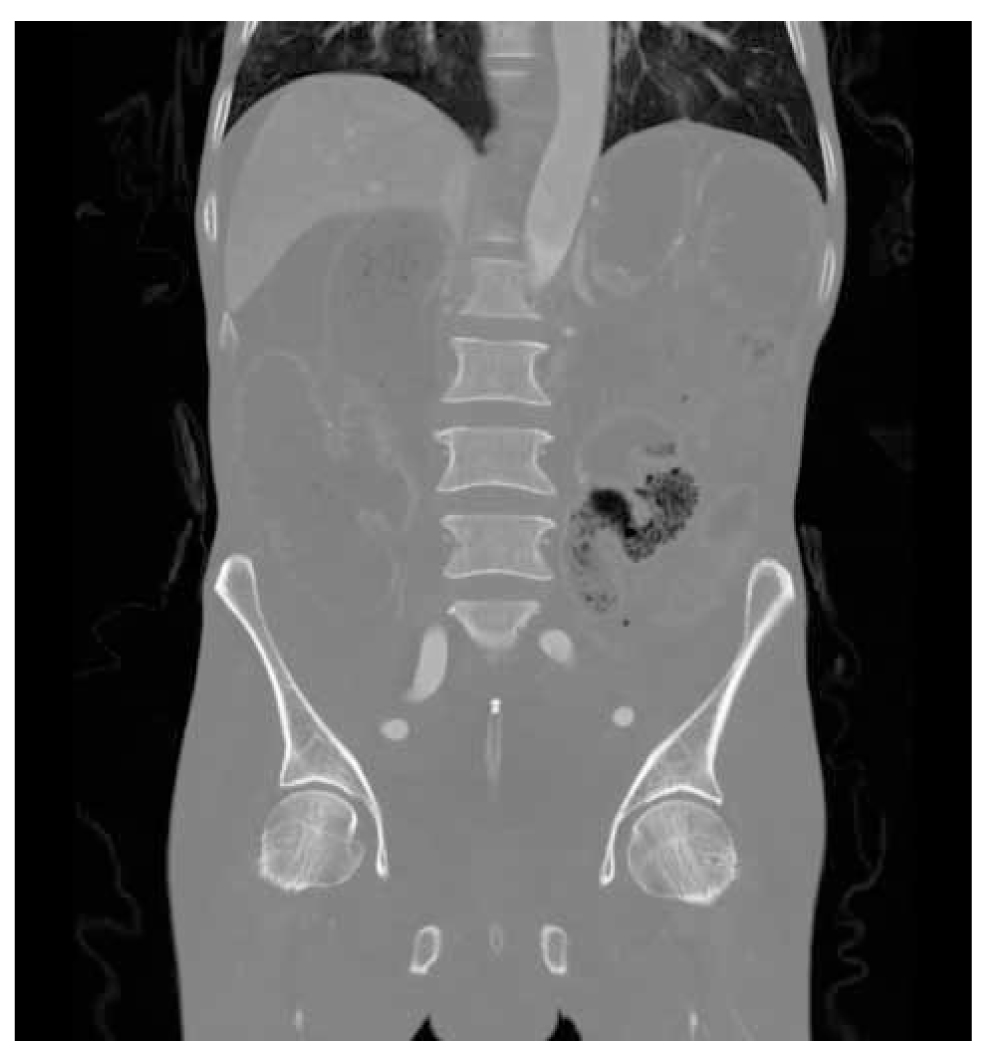
Figure 1. ct of the patient.
Discussion
Metastases to the gastrointestinal system are rare. Overall, the incidence of metastases to the upper and lower gastrointestinal tract is 0.03% and 0.05% of all metastatic sites, respectively. In the limited literature available on this subject, gastrointestinal metastases are mostly treated as a single group. However, management, treatment, and prognosis vary significantly depending on the metastatic site and the underlying primary tumour [3].
Recurrence of gastric cancer can present in a variety of ways and a high index of suspicion should be present. There are case reports describing the first symptoms of gastric adenocarcinoma as large bowel obstructions, suggesting that this malignancy is often diagnosed late and has an insidious nature. Well-defined routes of metastases after curative resection of gastric adenocarcinoma are lymphatics, peritoneal seeding, hematogenous spread, or local recurrence [4]. Lymph node metastasis is common both at the time of initial diagnosis of gastric cancer and at the time of diagnosis of metastases. However, only one article has reported metastasis to the rectum without any lymph node metastasis at the time of diagnosis of primary gastric cancer or at the time of occurrence of rectal metastasis [5,6]. Intestinal metastases from gastric cancer spread from the gastrocolic and mesenteric ligaments but are very rare and most cases are detected in postmortem studies. Rectal metastases in gastric adenocarcinomas have been reported in the literature. In those cases, intestinal metastases of poorly differentiated diffuse signet ring cell type gastric adenocarcinomas were detected and surgical treatment and/or chemotherapy were performed [7]. In a case report by Uemura et al., it was observed that early-stage gastric cancer metastasised to the rectum, and no metastases were observed in the abdomen or other solid organs. That study led to the thought that gastric cancer rectal metastasis occurs via hematogenous transmission [8]. In a study by Song et al., isolated cecum and rectum metastasis of gastric cancer was observed [9]. In the current case, moderately differentiated adenocarcinoma was observed, signet ring cells were not seen, and only lymph node metastasis was observed.
In conclusion, isolated rectal metastasis of gastric cancer is a very rare condition. It should be considered in patients presenting with constipation, intestinal obstruction findings and rectal bleeding. In cases with signs of constipation and intestinal obstruction, colonoscopy must be performed during treatment planning. Since rectal metastasis is considered distant metastasis, the prognosis remains poor.
Conflict of interest
All authors confirms that they have no conflicts of interest.
REFERENCES
- Durhan A, Senlikci A, Kosmaz K, Erguder E, Mercan U, Suleyman M. An evaluation of the effect of preoperative inflammation-based factors on survival in gastric cancer patients. J Coll Physicians Surg Pak. 2021 Mar;31(3):282-7.
- Tang L, Li H, Lv J, Fang C, Zhang H, Meng J. Rectal metastasis of gastric cancer: A case report. J Int Med Res [Internet]. 2023 Oct;51(10):3000605231198407. Available from: https://pmc.ncbi.nlm.nih.gov/articles/PMC10566277/
- Janjic O, Labgaa I, Hübner M, Demartines N, Joliat GR. Metastasis to the rectum: A systematic review of the literature. Eur J Surg Oncol. 2022 Apr;48(4):822-33.
- Bolliet M, Green M, Damadi A. Gastric adenocarcinoma metastasis to the rectum causing complete obstruction, a case report. J Surg Case Rep [Internet]. 2023 Oct;(10):rjad560. Available from: https://pmc.ncbi.nlm.nih.gov/articles/PMC10590633/
- Fretwell VL, Kane EG, MacPherson S, Skaife P. Metastases from gastric cancer presenting as colorectal lesions: A report of two cases and systematic review. Ann R Coll Surg Engl. 2025 Jan;107(1):76-82.
- Lim SW, Huh JW, Kim YJ, Kim HR. Laparoscopic low anterior resection for hematogenous rectal metastasis from gastric adenocarcinoma: A case report. World J Surg Oncol 2011 Nov;9:148.
- Tural D, Selçukbiricik F, Erçalışkan A, Inanç B, Günver F, Büyükünal E. Metachronous rectum metastases from gastric adenocarcinoma: A case report. Case Rep Med [Internet]. 2012 Nov;2012:726841. Available from: https://onlinelibrary.wiley.com/doi/10.1155/2012/726841
- Uemura N, Kurashige J, Kosumi K, Iwatsuki M, Yamashita K, Iwagami S, et al. Early gastric cancer metastasizing to the rectum, possibly via a hematogenous route: A case report and review of literature. Surg Case Rep. 2016 Dec;2(1):58.
- Song Y, Song C, Fan Z. A rare case of advanced gastric cancer with synchronous metastasis to the mucosal layer of the cecum and rectum. Asian J Surg [Internet]. 2024 Nov;S1015-9584(24)02701-5. Available from: https://pubmed.ncbi.nlm.nih.gov/39613590/